Why Compression Gear Feels Looser the Second Time You Wear It
Quick Answer: Elastane fibres stretch under load and need time and, ideally, a wash cycle to return to their original length. Worn twice in a row without a wash, compression garments typically deliver noticeably less pressure the second time. Most of that recovery comes back with laundering — permanent loss comes from heat, oils, and chlorine rather than from wearing them.
The first run in the new compression tights felt like the marketing described.
You wore them again on Thursday without washing them and they felt like ordinary leggings.
Neither wear was a fluke. The fibre needed a rest.

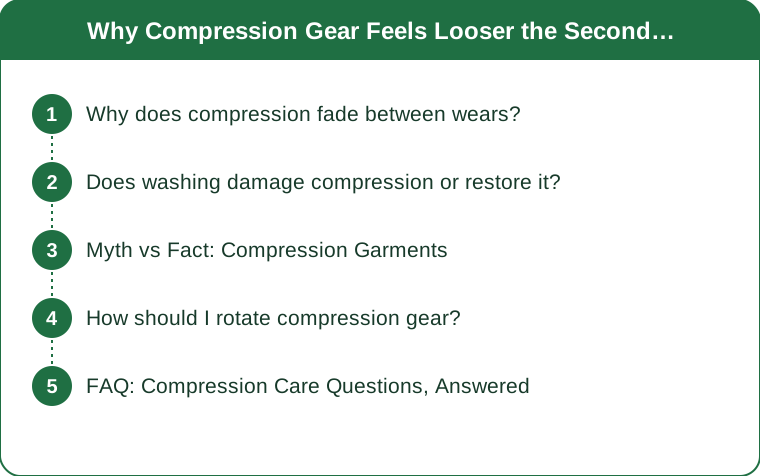
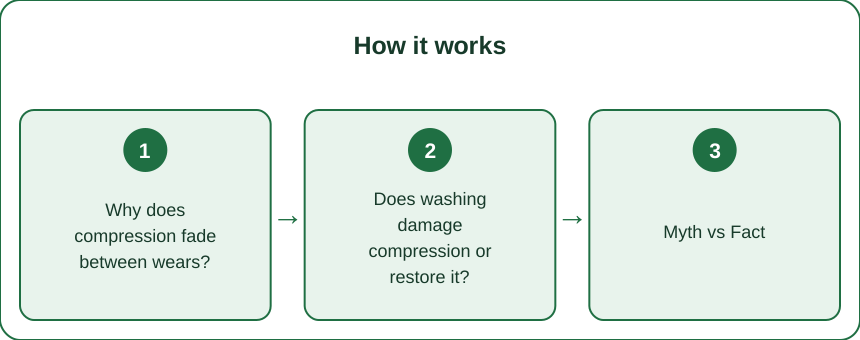
Why does compression fade between wears?
Because elastane is a mechanical spring, and springs held under load do not return instantly.
Elastane — the fibre branded as Lycra or Spandex — is made of long polymer chains arranged so they can extend several times their resting length and pull back. That pull-back is what produces compression.
When you wear a compression garment, the fibres are held stretched for the duration. Over hours under tension, some of the polymer chains slip past each other into a new arrangement rather than simply extending and returning. This is a well-known behaviour in polymers, and the effect is that the fibre does not immediately return to its original resting length when unloaded.
Recovery happens, but it takes time. Leave the garment relaxed and it gradually contracts back toward its starting dimensions. A few hours restores most of it. A wash cycle restores considerably more, because warm water and agitation help the polymer chains relax back into their preferred arrangement.
So the sequence most people follow — wear, drop on the floor, wear again the next day — gives the fibre the least favourable conditions available. It has been held stretched, then left folded on a floor for twelve hours, then loaded again before recovering.
The compression is genuinely lower on that second wear. Measured pressure drops of 10 to 20 percent are typical for a second consecutive wear without laundering.
Does washing damage compression or restore it?
Washing correctly restores it. Washing incorrectly destroys it. Both statements are true and the difference is heat.
What restores compression:
- Cold or cool water. Helps the fibre relax back without degrading it.
- Prompt washing after wear. Body oils and sweat residue accumulate in the fibre and interfere with elastic recovery. The longer they sit, the more they penetrate.
- A gentle cycle. Enough agitation to clean, not enough to stress seams.
What destroys it:
- Heat, above everything else. Hot water and especially tumble drying are the primary cause of permanent compression loss. Elastane begins to degrade at temperatures a domestic dryer reaches easily, and the damage is cumulative and irreversible.
- Fabric softener. It works by coating fibres, and a coated elastane fibre cannot recover properly. It also traps odour in synthetic fabrics rather than removing it.
- Chlorine. Devastating to elastane. Pool users see compression garments fail within a season.
- Prolonged direct sunlight during drying. UV breaks down the polymer.
- Body oils and sunscreen left to sit. Both degrade elastane over time, which is why summer garments often age faster than winter ones.
The optimal routine is genuinely simple: cold wash promptly, no softener, hang dry away from direct sun and radiators. That routine can extend usable compression life from roughly a year to two or three.

Myth vs Fact: Compression Garments
Myth: If it feels loose, it has stretched out permanently. Fact: Usually it is temporary, and a cold wash and full dry restores most of it. Judge permanent loss by how it feels on the first wear after washing, not by how it feels on a second consecutive wear.
Myth: Tighter is better. Fact: Compression garments are designed for a pressure range. Sizing down does not give you more benefit — it gives you a pressure that can restrict rather than assist, along with more discomfort and faster fibre fatigue.
Myth: You should size down as they age. Fact: If a garment has genuinely lost its compression, a smaller size in the same worn-out fabric does not restore the pressure profile. Replace it rather than compensating.
Myth: Hand washing is always better. Fact: A cold gentle machine cycle is fine and often better, since hand washing rarely rinses detergent out completely and residue interferes with fibre recovery.
Myth: More elastane means better compression. Fact: Knit structure, fabric weight, and panel construction matter as much as elastane percentage. A well-constructed 15 percent elastane fabric can out-compress a poorly constructed 25 percent one, and higher elastane content is often less durable.
How should I rotate compression gear?
Rotation is the practical answer to almost all of this.
Own at least two pairs if you train more than twice a week. This is the single change that solves the problem, because it means a garment is never worn twice without a wash and always gets a full recovery period.
Give each garment 24 hours flat and unstretched between wears. Hung or laid flat, not balled up in a bag, which holds the fabric in a distorted shape while it is trying to recover.
Wash after every wear for anything you want to keep its compression. Compression garments are the one category where the every-wear rule genuinely matters, because oil accumulation degrades the fibre rather than just smelling bad.
Keep the newest pair for the sessions that need it. Compression declines gradually, so let the older pair take the easy days and the newer pair take races, long runs, or recovery use where the pressure actually matters.
Retire on function, not appearance. Compression garments usually look fine long after they have stopped compressing. If it slides down, no longer marks your skin faintly after a session, or is easy to pull on when it used to be a struggle, its working life is over regardless of how it looks.
Expect roughly a year of regular use. Two to three years with careful washing and rotation, and considerably less with regular tumble drying or chlorine exposure. Autumn is a reasonable point to assess the set you have been using all summer, since sunscreen and heat will have taken their toll.
FAQ: Compression Care Questions, Answered
Can I put them in the dryer on low?
Better than high, still worse than hanging. Low heat cycles vary widely between machines and many run hotter than labelled. Since they hang-dry quickly anyway, the dryer offers little benefit and real risk.
Does wearing compression all day reduce its effectiveness?
For the garment, yes — longer under load means more recovery needed. For you, extended low-grade compression is fine for most people, though medical-grade garments come with specific wearing instructions that should be followed as given.
How do I tell medical-grade from athletic compression?
Medical compression is specified in mmHg with a defined gradient and is usually prescribed. Athletic compression rarely publishes pressure figures and is not a substitute where a clinician has prescribed a specific grade.
TL;DR:
- Elastane stretches under load and needs hours, ideally plus a wash, to recover its resting length
- A second consecutive wear without washing typically loses 10 to 20 percent of the pressure
- Cold wash promptly, no fabric softener, hang dry — heat is what causes permanent loss
- Chlorine, sunscreen, and body oils are the other main fibre killers
- Own at least two pairs and give each 24 hours flat between wears
- Retire based on whether it still compresses, not on how it looks
The Thursday pair had not worn out. It had not finished recovering from Tuesday. Wash it cold, hang it up, and it will feel like the first run again.
See It in Motion
Seen here: High Waist Yoga Leggings with Side Pockets — shop it on bubblelime.com
Keep Reading
This article is for general informational and styling purposes only. Fit, sizing, and product availability may vary.