Compression Socks for Desk Days: Sitting Is a Different Problem From Standing
Quick Answer: Sitting causes leg swelling because the calf muscle pump - the mechanism that pushes blood back up your legs - is essentially switched off, and a bent knee and hip add mechanical restriction on top. Graduated compression helps by supporting venous return while the pump is idle, and a lower compression class is generally appropriate for sitting than for medical conditions. But compression is a supplement to movement, not a replacement: standing and walking for a couple of minutes every half hour does more than any sock.
Your ring is tight by four in the afternoon and you haven’t taken a step since lunch. That’s not a coincidence - it’s the mechanism.

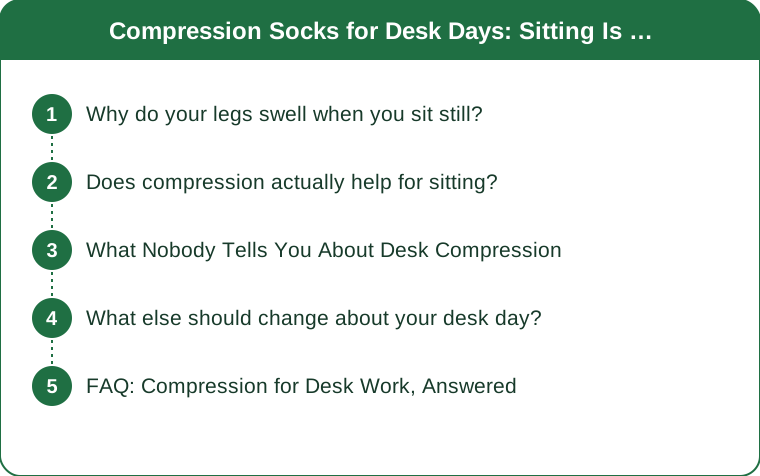
Why do your legs swell when you sit still?
The calf muscle pump stops working. Every time your calf contracts during walking, it squeezes deep veins and pushes blood upward against gravity. Sitting removes those contractions, so venous return relies on much weaker mechanisms.
Gravity keeps working regardless. With your feet down and your legs still, fluid tends to accumulate in the lower legs and ankles. The longer the sitting period, the more noticeable it becomes.
A bent knee and hip add restriction. The seated position compresses at the hip and knee, and a chair edge pressing into the back of the thigh adds another point of restriction - which is why chair height and depth matter more than most people realise.
Standing all day is a different mechanism. Standing at least keeps some muscle activity going and periodic weight shifting; the problem there is sustained venous pressure over long periods. Both produce swelling, via different routes.
Air travel is the extreme version. Prolonged immobility in a seated position, which is why compression is standard advice for long flights - the same mechanism as a desk day, concentrated.
And it’s worse in warm conditions. Vessels dilate in heat, which is why late-summer office days with the air conditioning off produce noticeably more swelling than the same day in winter.
Does compression actually help for sitting?
Graduated compression supports venous return mechanically. By applying more pressure at the ankle and less further up, it helps counteract the pooling that occurs when the muscle pump is idle. Graduated is the key word - uniform pressure doesn’t do the same job.
The evidence is strongest for specific situations. Compression is well-established for long-haul flights, for people with venous insufficiency or varicose veins, and post-surgery. For general office comfort the evidence is softer, but many people find it noticeably reduces the end-of-day heavy feeling.
Lower classes are appropriate for general use. Light support levels, commonly described in the 15-20 mmHg range, are typical for travel and general comfort. Higher medical-grade compression is prescribed for specific conditions rather than chosen for a desk.
Fit matters more than compression class. A sock that’s the wrong size delivers the wrong pressure profile, and one that rolls or bunches at the top can create a tourniquet effect - which is the opposite of what you want.
They’re not a treatment for an underlying condition. This is general information, not medical advice. Swelling in one leg only, swelling with pain, redness, or warmth, or new sudden swelling needs urgent medical assessment rather than a sock, because it can indicate a clot.
And some people shouldn’t use them without advice. Certain circulatory conditions, peripheral arterial disease, diabetes with neuropathy, and some skin conditions all warrant a clinician’s input before starting compression.

What Nobody Tells You About Desk Compression
Movement beats compression, comfortably. Two minutes of standing and walking every thirty minutes does more for leg swelling than any sock. The sock is for the hours you genuinely can’t move.
Put them on before the swelling starts. Compression works best applied first thing, before fluid has accumulated. Putting them on at 4pm when your ankles are already puffy is much less effective and much harder.
Chair height changes everything. Feet flat on the floor with knees at roughly hip height reduces the pressure at the back of the thigh. A chair that’s too high leaves the front edge digging in, which restricts flow directly.
Crossed legs are worse than people assume. It’s not dangerous, but it does restrict flow and it’s a habit that compounds over an eight-hour day.
Knee-high beats thigh-high for most desk use. Knee-highs cover the main pooling area and are far less likely to roll or bunch, which is the most common practical failure.
And they degrade invisibly. Elastic fatigues with washing and wear, and a sock that still feels snug may have lost much of its graduated profile. Most manufacturers suggest replacing after a number of months of regular use - the ones that feel comfortable are often the ones that have stopped working.
What else should change about your desk day?
Set a movement prompt every thirty minutes. A timer, a calendar block, or a rule attached to something - standing for every phone call. The prompt matters more than the specific interval.
Do ankle pumps at the desk. Heels down, toes up, twenty repetitions, a few times a day. It activates the calf pump directly without standing up, and it’s the single most useful thing you can do while seated.
Raise your feet when you can. Even a low footrest that lifts your feet slightly helps, and putting your legs up properly for ten minutes in the evening does more than an hour of sitting normally.
Drink water rather than restricting it. People with swollen ankles often reduce fluid intake, which is generally the wrong direction. Adequate hydration supports circulation.
Watch salt and check medications. High sodium intake contributes to fluid retention, and some medications list swelling as a side effect - worth checking with a pharmacist if it started when a medication did.
And get one-sided or painful swelling checked promptly. Both legs mildly puffy after a long sitting day is common. One leg swollen, painful, warm, or red is a different situation and warrants urgent medical attention.
FAQ: Compression for Desk Work, Answered
Do compression socks help if I sit all day?
Many people find they reduce the heavy, swollen feeling by supporting venous return while the calf muscle pump is inactive. They’re a supplement to moving regularly rather than a substitute for it.
What compression level should I use for an office job?
Light support levels, commonly around 15-20 mmHg, are typical for travel and general comfort use. Higher medical-grade compression is prescribed for specific conditions rather than chosen for general desk use.
When should I put compression socks on?
First thing in the morning, before any swelling has developed. They’re far more effective applied before fluid accumulates, and considerably easier to put on.
When is leg swelling something to see a doctor about?
Swelling in one leg only, or swelling with pain, warmth, or redness, needs prompt medical assessment because it can indicate a clot. Persistent swelling, or swelling with breathlessness or chest symptoms, also warrants urgent attention.
TL;DR:
- Sitting switches off the calf muscle pump, so blood pools in the lower legs - a different mechanism from standing all day.
- Graduated compression supports venous return while the pump is idle; light support levels are typical for general desk use.
- Put them on first thing, before swelling develops - it’s more effective and far easier.
- Movement beats compression: two minutes of walking every half hour, plus ankle pumps at the desk.
- Compression degrades invisibly with washing, and one-sided, painful, warm, or red swelling needs urgent medical assessment.
The sock covers the hours you can’t move. It isn’t a replacement for the two minutes you can.
See It in Motion
Seen here: High Waist Yoga Leggings with Side Pockets — shop it on bubblelime.com
Keep Reading
This article is for general informational and styling purposes only. Fit, sizing, and product availability may vary.