How to Tell if Your Compression Leggings Are Actually Compression
Quick Answer: True compression applies measurable, usually graduated pressure - tightest at the ankle, decreasing upward - and is specified in mmHg. Most activewear labeled compression has no pressure rating at all and is simply a snug fit. Four quick checks: look for an mmHg figure, check whether the fabric is tighter at the ankle than the thigh, look for elastane content above about 20 percent, and see whether the size chart uses limb measurements rather than dress sizes.
The word compression is not regulated in activewear the way it is in medical hosiery. That is the entire source of the confusion.

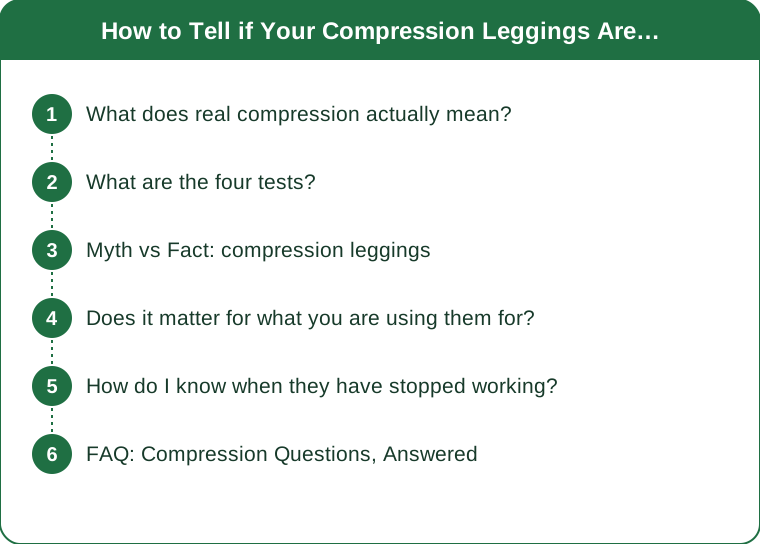
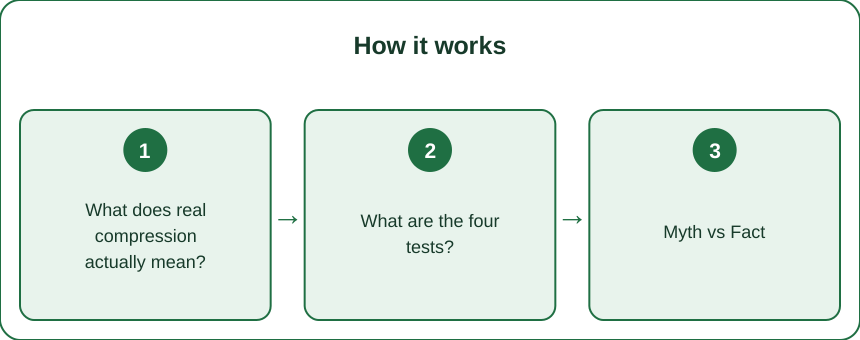
What does real compression actually mean?
It means a specified pressure, measured in millimeters of mercury (mmHg), applied to the limb.
Medical compression is categorized into classes: roughly 8 to 15 mmHg for mild, 15 to 20 for moderate, 20 to 30 for firm, and higher grades used under clinical supervision.
Graduated compression - the version with the best evidence - applies the highest pressure at the ankle and decreases moving up the leg, typically to about 40 to 70 percent of the ankle pressure at the calf. That gradient is what assists venous return against gravity.
Activewear brands are under no obligation to measure or publish any of this. A legging can be labeled compression because it is made from a firm fabric and feels supportive, with no pressure specification whatsoever.
Neither is dishonest exactly - a firm legging does provide some proprioceptive feedback and muscle support. It just is not the same product as a graduated compression garment, and it should not be expected to do the same job.
What are the four tests?
All four take under a minute and you can do them in a store.
1. Look for an mmHg number. On the label, the packaging, or the product page. If there is no number, there is no specified compression. This test alone answers the question most of the time.
2. Check the ankle-to-thigh gradient. Put them on and feel the difference. Real graduated compression is noticeably firmer at the ankle. If the pressure feels even up the whole leg, or tighter at the thigh, it is not graduated.
3. Check the elastane percentage. True compression fabrics typically run 20 to 40 percent elastane or spandex. Standard activewear is usually 12 to 20 percent. Under about 18 percent, meaningful compression is unlikely regardless of the label.
4. Look at the size chart. Compression garments are sized on limb circumference measurements - ankle, calf, thigh. Activewear sized S/M/L or by dress size is not being fitted for pressure, because pressure depends entirely on the ratio of garment circumference to limb circumference.
Myth vs Fact: compression leggings
Myth: Tighter means more compression. Fact: Uniform tightness without a gradient does not assist venous return and can, at high pressure with no gradient, impede it.
Myth: Compression leggings speed up muscle recovery. Fact: The evidence supports reduced perceived soreness fairly consistently. Evidence for faster actual recovery of strength and power is mixed and generally weaker.
Myth: You should size down for more compression. Fact: Sizing down produces uneven pressure, digging at the waistband and knee, and is the most common cause of the numbness people report.
Myth: Compression works for everyone. Fact: Response varies considerably between individuals, and people with peripheral arterial disease, certain neuropathies, or specific circulatory conditions should not use compression without medical advice. This is general information, not medical advice.

Does it matter for what you are using them for?
Enormously, and this is where the practical answer lives.
For flying, long standing shifts, or swelling: graduated compression with a stated mmHg is what you want. This is the use case with the strongest evidence, and a fashion legging labeled compression will not do the job. Look for 15 to 20 mmHg graduated as a general starting point.
For training support and proprioception: a firm, high-elastane legging is genuinely fine. The benefit here is largely about feeling supported and stable, and that does not require a pressure specification.
For perceived soreness after hard sessions: the research used graduated garments, but the effect is substantially subjective, and a firm legging worn for a few hours afterward is a reasonable low-cost approach.
For medical conditions - lymphedema, venous insufficiency, post-surgical: this is a fitted, prescribed product, not a purchase decision. Talk to your clinician. This is general information, not medical advice.
How do I know when they have stopped working?
Compression garments lose pressure well before they look worn out, which is the part people miss.
Elastane degrades with heat, UV, body oils, and repeated stretching. Medical compression stockings are generally recommended for replacement every 3 to 6 months with regular wear, and activewear compression follows a similar curve.
The practical test: put them on and note whether you still have to work to get them past the ankle. Compression that slides on easily has lost pressure. Another marker is the waistband - if it has stopped staying put, the elastane throughout has likely degraded too.
Care extends this meaningfully. Cold wash, no fabric softener, no dryer, and dry away from direct sun. Fabric softener in particular coats elastane fibers and accelerates the loss.
One genuinely useful habit: write the purchase month on the care tag in permanent marker. It takes 5 seconds and it removes all guessing about whether a pair is two years old.
FAQ: Compression Questions, Answered
Should I sleep in compression leggings?
Generally not, unless a clinician has advised it. Venous return does not need assistance against gravity when you are lying flat, and overnight wear increases the chance of constriction at a seam.
How long should I wear them after training?
Studies on perceived soreness typically used 1 to 4 hours post-exercise, some up to 24. There is no evidence that longer is better beyond that range.
Are compression socks better than leggings for flying?
For swelling and circulation on a flight, yes - a graduated sock or sleeve with a stated mmHg is the studied product. A general activewear legging is not a substitute.
TL;DR:
- Real compression has a stated mmHg figure and is graduated, tightest at the ankle.
- Four checks: mmHg on the label, ankle-to-thigh gradient, elastane above 20 percent, sizing by limb measurement.
- The word compression is unregulated in activewear, so most labeled pieces are simply firm.
- Firm leggings are fine for training support. For flying, swelling, or standing shifts, buy a rated graduated garment.
- Replace every 3 to 6 months of regular wear - they lose pressure long before they look worn.
Check the label on the pair you own right now. If there is no number on it, you have learned something useful about what to expect from it. This is general information, not medical advice.
See It in Motion
Seen here: Super High Waist Embossed Yoga Leggings with Inner Pocket — shop it on bubblelime.com
Keep Reading
This article is for general informational and styling purposes only. Fit, sizing, and product availability may vary.