How to Put On and Take Off Compression Without Wrecking It
Quick Answer: Do not pull compression on from the top. Roll or bunch the garment down to the foot or ankle first, ease it over the heel, then unroll it up the limb in stages, smoothing as you go. Never yank at the cuff, never use fingernails, and never grip a single spot - that is what breaks elastic fibres and creates the loose patches that make a garment stop working.
A good compression garment is expensive and has a defined working life. Most of them do not reach it, and the reason is not the washing machine - it is the way they are dragged on at 7am and peeled off at 9pm.

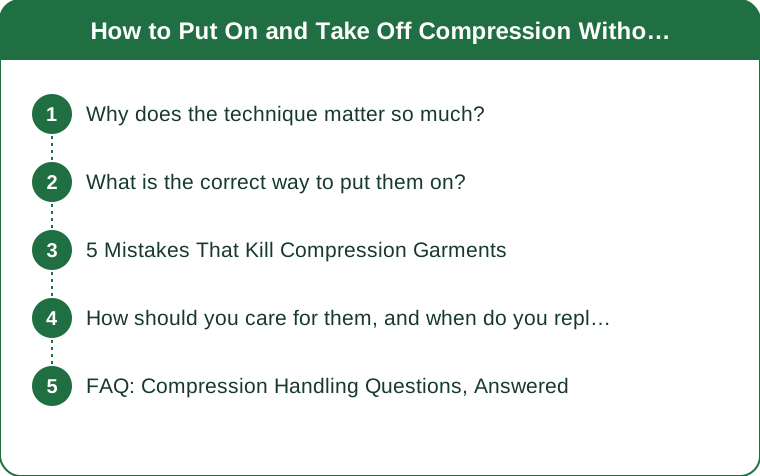
Why does the technique matter so much?
Because compression works by applying a specific pressure profile, and that profile depends on the elastic fibres being intact and evenly distributed.
A compression garment is knitted with elastane or similar fibres under tension. Graduated compression - the type used for circulation - is engineered to be tightest at the ankle and progressively looser up the limb, which is what encourages venous return upward. That gradient is designed into the knit.
Concentrated force destroys it locally. When you grip a garment at one point and pull hard, all of the force goes through the fibres at that spot. Elastane can be overstretched past its recovery point, and when it is, that section is permanently looser than the rest. You cannot see it, but the pressure profile now has a gap in it - and a graduated garment with a loose patch mid-calf is not doing what it was prescribed to do.
Nails do the visible version. A snag or a pulled thread in a compression knit spreads, because the whole structure is under tension. One catch on a fingernail or a ring can end a garment.
And repeated over-stretching at the cuff - which is where everyone pulls - is why the top band is usually the first part to go slack, and why garments start rolling down after a few months.
The economics are worth noting. Medical-grade compression typically retains its rated pressure for around three to six months of daily wear, and sports compression somewhat longer with lighter use. Damaging it in the first month means paying for it twice.
What is the correct way to put them on?
Five steps. It takes about the same time as the wrong way once you have done it twice.
1. Do it first thing in the morning, sitting down. Limbs are least swollen after lying flat overnight, which makes everything easier and gives the garment the best chance of doing its job through the day. Sit on the edge of a bed or a chair - standing on one leg while wrestling a compression sock is how people fall.
2. Prepare the garment. Reach inside, take hold of the heel from within, and turn the garment inside out down to the heel - so you have a small pocket for the foot and the rest bunched up. For sleeves, bunch the fabric down to the wrist.
3. Position the foot and heel properly. Slide the foot in and seat the heel pocket exactly over your heel before doing anything else. Almost every twisted, uncomfortable, poorly performing application starts with a heel that is half a centimetre off.
4. Roll it up in stages. Use the flats of your palms, not fingertips, and work the fabric upward a few centimetres at a time, all the way round the limb each time. Do not pull one side up and then the other.
5. Smooth out every wrinkle. Run your palms up the whole garment. A fold or a bunched section creates a pressure point, which is uncomfortable and can restrict circulation locally - the opposite of the intent.
Helpful tools: rubber washing-up gloves give grip without nails and make the whole process dramatically easier. Donning aids - a frame or a slip sock - are available and genuinely worth it for anyone with limited grip strength, arthritis, reduced mobility, or a large size difference to manage.

5 Mistakes That Kill Compression Garments
1. Pulling from the top band. The instinctive move, and the one that overstretches the cuff and puts all the load on one section. Roll from the bottom instead, always.
2. Using fingernails or wearing rings. A snag in a compression knit propagates. Take rings off, keep nails short if you wear compression daily, or use rubber gloves.
3. Applying them to damp skin or over lotion. Damp skin makes the garment stick and forces you to pull harder. Moisturise at night rather than in the morning, and let skin dry fully before donning.
4. Peeling them off from the top like a sock. Removal damages garments as much as application. Roll them down from the top by turning them inside out over themselves, rather than gripping the cuff and dragging. This is the half of the process nobody thinks about, and it accounts for a large share of the wear.
5. Wearing the same pair every day. Elastic needs time to recover its shape. Two pairs alternated last considerably more than twice as long as one pair worn daily, because each gets a full day to return to its resting dimensions.
How should you care for them, and when do you replace them?
Washing is where the remaining life is decided, and the timeline is shorter than most people assume.
Wash after every wear. Body oils and sweat degrade elastane, so a garment worn twice between washes ages faster than one washed daily. This is one of the few garments where washing more often is genuinely better.
Cool water, mild detergent, no fabric softener and no bleach. Softener coats and breaks down elastic fibres. Bleach destroys them outright.
Hand wash or a gentle machine cycle in a mesh bag. Hand washing is preferable - a few minutes in cool soapy water, gentle squeezing rather than wringing.
Never wring, never tumble dry, never radiator dry. Press between a towel to remove water, then lay flat or hang over a rack away from direct heat. Heat is the single fastest killer of elastane.
Replacement timeline: medical-grade compression is generally recommended to be replaced every three to six months of daily wear. Sports compression lasts longer with intermittent use but loses meaningful pressure within a year of regular training. If it goes on noticeably more easily than it used to, that is the signal - ease of application is a direct proxy for lost compression.
And check the fit periodically. Weight change, pregnancy, swelling patterns, and seasonal changes all alter limb measurements. A garment sized to a limb you no longer have is either ineffective or too tight.
See a doctor promptly if wearing compression causes numbness, tingling, colour changes in the toes or fingers, increasing pain, or skin breakdown, or if one limb becomes swollen, warm, red, or painful. Those need assessing rather than adjusting. This is general information, not medical advice.
FAQ: Compression Handling Questions, Answered
What is the easiest way to put on compression socks?
Sitting down, first thing in the morning, with the sock turned inside out to the heel. Seat the heel first, then roll it up the leg in stages using your palms. Rubber washing-up gloves make it substantially easier.
How often should you replace compression garments?
Medical-grade compression is typically replaced every three to six months of daily wear. If it becomes noticeably easier to put on, it has lost pressure and needs replacing.
Can you machine wash compression socks?
Yes, on a cool gentle cycle in a mesh bag with mild detergent and no fabric softener. Never tumble dry or dry on a radiator - heat destroys the elastic fibres.
TL;DR:
- Roll from the bottom, never pull from the cuff - concentrated force permanently overstretches fibres.
- Seat the heel first, work upward with your palms, and smooth out every wrinkle.
- Removal matters as much as application: roll them down, do not drag them off.
- Wash after every wear in cool water, never tumble dry, and replace every three to six months.
The garment is doing precise work. Thirty seconds of technique at each end of the day is what keeps it precise.
See It in Motion
Seen here: Super High Waist Embossed Yoga Leggings with Inner Pocket — shop it on bubblelime.com
Keep Reading
This article is for general informational and styling purposes only. Fit, sizing, and product availability may vary.