How Tight Should Compression Leggings Actually Be?
Quick Answer: Medical compression is measured in mmHg and starts around 15-20mmHg for mild therapeutic use. Most athletic compression leggings sit well below that and are not measured at all - they are simply tight-fitting. That means the proprioceptive and comfort benefits are real while the circulatory claims usually are not. Fit should be firm and even with no numbness, no deep marks, and full range of motion.
Tight is not a specification. It is a feeling, and the industry relies on you not knowing the difference.

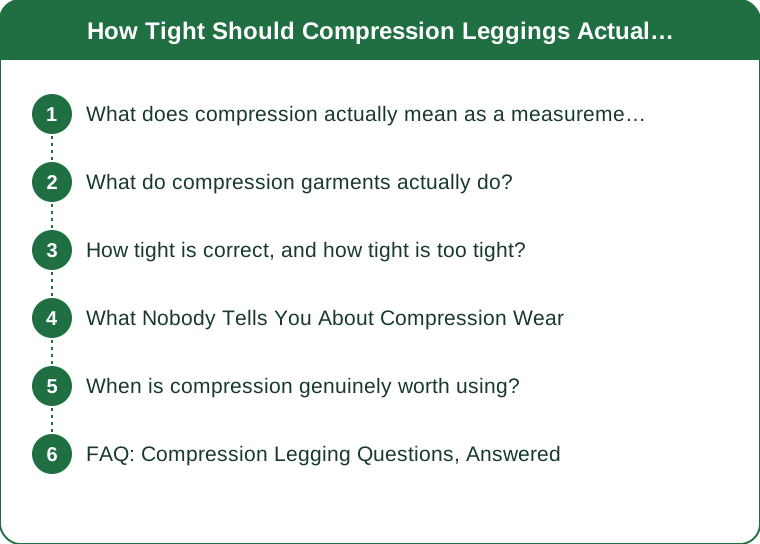
What does compression actually mean as a measurement?
It is a pressure specification, and almost no athletic legging gives you one.
Medical compression garments are measured in millimetres of mercury (mmHg) at specific points on the limb, and they are graded:
- 8-15mmHg: mild, often for travel and light swelling
- 15-20mmHg: moderate, the common over-the-counter therapeutic range
- 20-30mmHg and above: medical grade, typically prescribed and fitted
Graduated compression means the pressure is highest at the ankle and decreases up the leg, which is the design that supports venous return. This is what the circulatory claims are based on, and it requires deliberate engineering.
Most athletic compression leggings do not state a mmHg value, are not graduated, and deliver considerably less pressure than the therapeutic range. The word compression on athletic wear is a description of fit, not a specification.
Which does not mean they are useless. It means the benefits are probably not the circulatory ones being implied.
How to tell what you have: if the packaging states a mmHg range and mentions graduated compression, it is a compression garment. If it just says compression fit, it is a tight legging. Both can be worth owning; only one supports the claims.
What do compression garments actually do?
Separating what has support from what is marketed.
Reasonably supported:
- Reduced perceived muscle soreness after exercise. One of the more consistent findings across compression research, though effect sizes vary.
- Improved proprioception - your sense of where your limbs are. Firm fabric against skin provides sensory feedback, and this plausibly explains part of why people report feeling more stable and controlled.
- Reduced muscle oscillation during high-impact activity, which may contribute to the soreness findings.
- Genuine therapeutic effects in medical-grade graduated garments for venous conditions, swelling, and long-haul travel - this is well established and it is specifically about properly specified garments.
Weakly supported or mixed:
- Improved performance during exercise. Evidence is inconsistent and effects, where found, are small.
- Faster recovery of actual performance, as opposed to perceived soreness.
- Improved circulation during exercise in non-graduated athletic wear.
Not supported:
- Reducing cellulite
- Detoxification or lymphatic drainage claims in ordinary athletic wear
- Fat loss in compressed areas
A fair summary: feeling better and feeling more supported are real outcomes, and they are worth something. The physiological performance claims are considerably weaker than the marketing suggests.
How tight is correct, and how tight is too tight?
Practical tests, since you will not have a mmHg number to work from.
Correct feels like: firm, even pressure across the whole leg. Present but not restrictive. You notice it when you put them on and largely forget about it within ten minutes.
Too tight shows up as:
- Numbness, tingling, or pins and needles. The clearest stop signal there is - it indicates nerve compression and should never be tolerated.
- Deep indentation marks that persist for more than a few minutes after removal
- Restricted range of motion - if you cannot achieve a full squat or lunge, they are limiting you
- Difficulty taking a full breath with high-waisted styles
- Colour change in your feet, or feet feeling cold
- Pain anywhere, at any point
Too loose shows up as: rolling at the waist, sliding down, bunching behind the knee, and providing no sensation of support at all. At that point you have leggings, which is fine - just not what you paid for.
The specific tests to run:
The squat test. Full depth, and check both mobility and opacity.
The two-finger waistband test. You should be able to slide two fingers into the waistband. Less than that and it will dig in through a session.
The ten-minute test. Wear them around the house. Discomfort that is present at ten minutes will be worse at forty, and this is where most sizing mistakes become obvious.
The removal check. Look at the marks. Even light marks that fade within a few minutes are fine; deep lines that persist mean too tight.

What Nobody Tells You About Compression Wear
Sizing down to get more compression is the most common and least advisable approach. A garment engineered for compression achieves it through fabric and construction, not through being too small. Sizing down gets you restriction, rolling, digging, and reduced range of motion. If you want more compression, buy a garment that specifies more.
Compression garments lose their compression. Elastane degrades with heat, washing, sweat, and stretching, and a garment two years old delivers meaningfully less pressure than it did new. Medical compression garments are typically replaced every 3 to 6 months with regular use - athletic versions are not held to that standard, but they degrade the same way.
The way you put them on matters. Roll them up gradually rather than pulling from the top, which is how seams tear and how the fabric gets over-stretched in one place.
Wearing them all day is not necessarily better. For post-exercise recovery, a few hours is what most protocols use. For medical compression, follow the prescribing advice - some are meant to be removed at night.
Sleeping in athletic compression is not recommended unless a clinician has advised it. Circulation and position change during sleep, and unmonitored compression overnight is not the same proposition as wearing it while awake and moving.
Compression is not appropriate for everyone. Peripheral arterial disease, certain heart conditions, diabetes with neuropathy, and skin infections are all situations where compression can cause harm. If you have a circulatory condition, this is a conversation with a doctor rather than a retail decision. This is general information, not medical advice.
And the thing most people actually want to know: the smoothing effect is real and it is what a large share of people are buying. That is a legitimate reason to buy compression leggings. It is just not a physiological benefit, and it does not require the highest-compression garment on the shelf.
When is compression genuinely worth using?
Specific situations where it earns its place.
Post-exercise recovery. The soreness findings are among the better-supported, and wearing compression for a few hours after a hard session is a low-cost intervention with a plausible benefit.
Long-haul travel. Graduated compression socks for flights are supported for reducing swelling and are commonly recommended for reducing clot risk in longer flights, particularly for people with risk factors. This is a genuine medical use and it needs a properly specified graduated garment, not athletic leggings.
High-impact activity where muscle oscillation is uncomfortable. Running, jumping, court sports. The reduced-oscillation effect is real even if its downstream benefits are debated.
Standing all day. Nurses, teachers, retail workers, hospitality. Graduated compression in the 15-20mmHg range is a common recommendation for leg fatigue and swelling from prolonged standing.
Medically indicated situations - venous insufficiency, lymphoedema, post-surgical - where a clinician specifies the grade and fit. These should be professionally fitted rather than bought by guesswork.
Where it adds little: general gym sessions where you simply prefer a fitted feel. That is a comfort preference and a perfectly good one - just do not pay a premium expecting a physiological return.
The honest bottom line: buy compression leggings because you like how they feel and how they look, and treat any performance benefit as a bonus. Buy actual graduated compression, with a stated mmHg, when you have a specific reason - travel, standing all day, or a medical indication.
FAQ: Compression Legging Questions, Answered
How do I know what compression level I am getting?
If the product does not state a mmHg range, you are almost certainly getting a tight-fitting legging rather than a specified compression garment. Only medical and semi-medical products typically state the number.
Should I size down for more compression?
No. Sizing down produces restriction, rolling and digging rather than proper graduated pressure. Buy a garment specified for the compression you want.
Can I sleep in compression leggings?
Generally not advisable unless a clinician has told you to. Circulation and position change overnight, and unmonitored compression is a different situation from wearing them while awake.
How long do compression garments last?
Medical compression is typically replaced every 3 to 6 months with regular wear. Athletic compression degrades similarly - the tightness fades before the fabric looks worn.
Who should avoid compression garments?
Anyone with peripheral arterial disease, certain heart conditions, diabetic neuropathy, or active skin infections should get medical advice first. Numbness, tingling, colour change or pain means take them off. This is general information, not medical advice.
TL;DR:
- Real compression is measured in mmHg and graduated; most athletic leggings are neither
- Reduced perceived soreness and better proprioception are reasonably supported; performance claims are not
- Firm and even, two fingers in the waistband, no numbness, no persistent deep marks, full squat depth
- Never size down for more compression - buy a garment that specifies it
- Graduated compression is genuinely worth it for travel, standing all day, and medical indications
Buy them because you like them. Treat any physiological benefit as a bonus.
See It in Motion
Seen here: High Waist Embossed Yoga Leggings with Side Pockets — shop it on bubblelime.com
Keep Reading
This article is for general informational and styling purposes only. Fit, sizing, and product availability may vary.