Does Compression Actually Help Recovery, or Does It Just Feel Good?
Quick Answer: The strongest evidence for compression wear is in reducing perceived muscle soreness and the sensation of fatigue after exercise. Evidence for improved performance during exercise is weak and inconsistent. Medical-grade graduated compression has well-established uses for circulatory conditions, but sports compression garments typically apply lower and less consistent pressure than the medical versions.
It is one of the few areas of sports kit where the subjective experience is well supported and the mechanistic claims mostly are not.

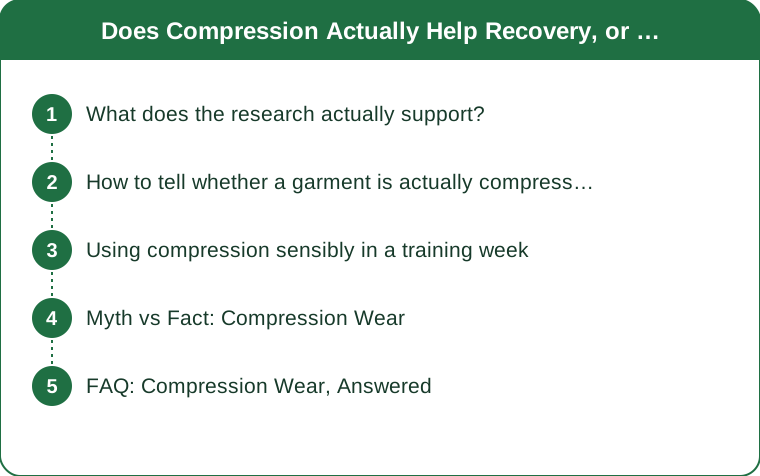
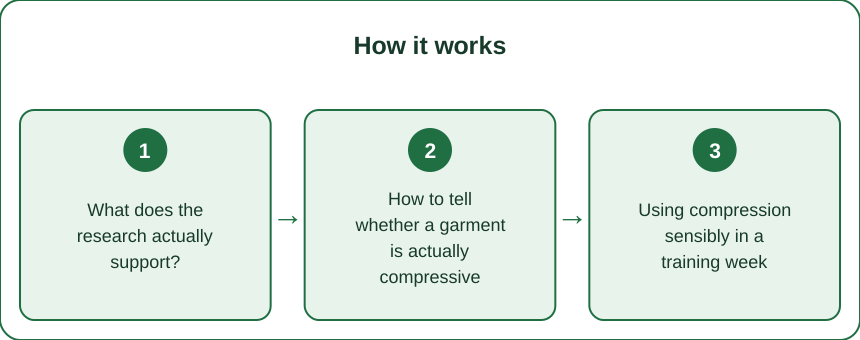
What does the research actually support?
A narrower set of things than the marketing suggests, but not nothing.
Reasonably well supported - reduced perceived soreness. Multiple studies and meta-analyses have found that wearing compression garments after exercise reduces reported delayed-onset muscle soreness in the following days. The effect is consistent enough to be one of the more reliable findings in recovery research.
Reasonably well supported - perceived recovery and comfort. People report feeling less fatigued and more recovered. Whether this is mechanical, placebo, or both is not fully resolved - and for a recovery aid, a reliable perceptual benefit has genuine practical value.
Mixed evidence - markers of muscle damage. Some studies show reduced creatine kinase or improved return of strength; others show no difference. The picture is inconsistent across protocols and populations.
Weak evidence - performance during exercise. Studies on running economy, power output and time to exhaustion while wearing compression are largely unconvincing. Where effects appear they are small and inconsistently replicated.
Well established, but different - medical graduated compression. For conditions such as venous insufficiency, lymphoedema and prevention of travel-related clots in at-risk people, graduated compression stockings have a solid clinical evidence base. These are prescribed at specified pressures and are a distinct category from sports leggings marketed as compression.
The honest summary: compression is a good recovery comfort tool with a real perceptual effect, an unconvincing performance tool, and a genuinely effective medical device when it is the medical version prescribed for a medical reason. This is general information, not medical advice - circulatory symptoms warrant proper assessment.
How to tell whether a garment is actually compressive
Most ‘compression’ activewear is not, in any meaningful technical sense.
What medical compression specifies: a pressure at the ankle measured in millimetres of mercury, decreasing up the leg - graduated compression. Medical classes typically start around 15 to 20 mmHg and go considerably higher.
What sports compression usually is: a tight-fitting garment with no stated pressure, no verified gradient, and pressure that varies with fit, wash count and body shape. A tight legging is not automatically a compression garment.
How to assess what you have:
- Does the product state a pressure in mmHg? If not, it is a fit description rather than a specification.
- Is it graduated? Genuine graduated garments state that they are tighter at the ankle.
- Does it leave a uniform mark, or a deep line at one point? A deep constriction line means uneven pressure, which is the opposite of the intent.
- How old is it? Compression garments lose pressure with washing and wear - often significantly within six to twelve months of regular use.
Fit matters more than the label:
- Size by the manufacturer’s measurements, not by your usual size. Compression sizing is based on limb circumference.
- Too large delivers no compression; too small delivers uneven compression and can be genuinely uncomfortable
- Rolling, bunching behind the knee, or digging at the waistband all indicate poor fit rather than a poor product
When to be cautious: compression is not appropriate for everyone. People with peripheral arterial disease, certain neuropathies, or skin conditions should not use compression without medical advice, and anyone with diabetes-related circulatory issues should consult a healthcare professional first.

Using compression sensibly in a training week
Where it earns its place, and where it is simply comfortable.
After hard sessions - the best-supported use.
- Put it on within an hour or two of finishing and wear for several hours
- Some protocols use overnight wear, which is well tolerated by most people and produces the most consistently reported soreness benefit
- Most useful after unfamiliar or eccentric-heavy work - downhill running, a return to lifting, a long hike - where soreness is highest
During travel - the clearest practical case.
- Long-haul flights and long drives are where graduated compression has genuine established support for at-risk individuals
- The leg swelling and heaviness after a long journey is the symptom most people notice improving
- Speak to a doctor about appropriate compression class if you have risk factors for clots
During exercise - mostly a comfort choice.
- Reduced muscle oscillation is real and measurable, and some people find it noticeably more comfortable, particularly for running
- Do not expect performance gains - the evidence does not support them
- The comfort and the reduced chafing are legitimate reasons to wear it, without needing a physiological justification
On standing occupations: many people who stand for long shifts find compression genuinely reduces end-of-day leg heaviness. This overlaps with the medical use case and is worth discussing with a healthcare professional if symptoms are significant.
Care that preserves the pressure:
- Cold wash, no fabric softener, air dry. Heat destroys elastane, which is where the compression comes from.
- Rotate two pairs rather than washing one constantly
- Replace when the fit noticeably loosens, typically within a year of regular use
Myth vs Fact: Compression Wear
Myth: Compression flushes lactic acid out of your muscles. Fact: lactate clears from the blood within roughly an hour of exercise on its own and is not the cause of delayed-onset soreness, which appears a day or two later and relates to muscle damage and inflammation. The lactic acid explanation has been outdated for decades.
Myth: Tighter means more effective. Fact: excessive or uneven pressure is counterproductive and can impair circulation. Graduated pressure at appropriate levels is the design intent, not maximum tightness.
Myth: Compression improves performance. Fact: the performance evidence is weak and inconsistent across running economy, power and endurance measures. Wear it for comfort and recovery, not for a time improvement.
Myth: All tight leggings are compression garments. Fact: most are not. Without a stated pressure in mmHg and a graduated design, you are buying a fit rather than a specification.
Myth: Compression garments last as long as normal leggings. Fact: the pressure comes from elastane, which fatigues with heat, washing and stretch. A garment can look perfect and have lost most of its compressive function, often within a year.
FAQ: Compression Wear, Answered
Does compression actually reduce soreness?
The evidence for reduced perceived soreness after exercise is reasonably consistent. Whether the mechanism is mechanical, perceptual or both is less settled - but the practical benefit is well reported.
Should I wear it during or after exercise?
After, if you are choosing one. The recovery evidence is stronger than the performance evidence, and wearing it for several hours or overnight after hard sessions is the best-supported use.
Are my leggings actually compression?
Only if they state a pressure in mmHg and are graduated - tighter at the ankle than the calf. Most sports leggings marketed as compression are simply tight-fitting.
How long do compression garments last?
Often six to twelve months of regular use before the pressure drops noticeably. Cold wash, no softener and air drying extend that considerably.
Is compression safe for everyone?
No. People with peripheral arterial disease, certain neuropathies, or diabetes-related circulatory issues should speak to a healthcare professional first. This is general information, not medical advice.
TL;DR:
- The best-supported effect is reduced perceived soreness after exercise, not improved performance
- Medical graduated compression is a different, well-evidenced category with stated pressures
- Most ‘compression’ leggings state no pressure and are simply a tight fit
- Best use is after hard eccentric sessions and during long journeys
- Pressure fades with washing and heat - replace within a year of regular use
Compression is a good comfort and recovery tool with a modest, real effect. It is not a performance aid, and the tight leggings in your drawer are probably not compression garments at all.
See It in Motion
Seen here: Super High Waist Embossed Yoga Leggings with Inner Pocket — shop it on bubblelime.com
Keep Reading
This article is for general informational and styling purposes only. Fit, sizing, and product availability may vary.