Compression Socks vs. Compression Sleeves — Which One Actually Fits Your Need?
Quick Answer: Compression socks cover the foot and lower leg and are better for circulation support, travel, and all-day wear including standing jobs. Compression sleeves cover only the calf (no foot coverage) and are typically preferred for running and workouts where foot freedom and breathability matter more.
You’ve seen both at the running store and honestly assumed they did the same thing. They mostly don’t — and picking the wrong one for your actual need means missing out on the specific benefit you were going for.
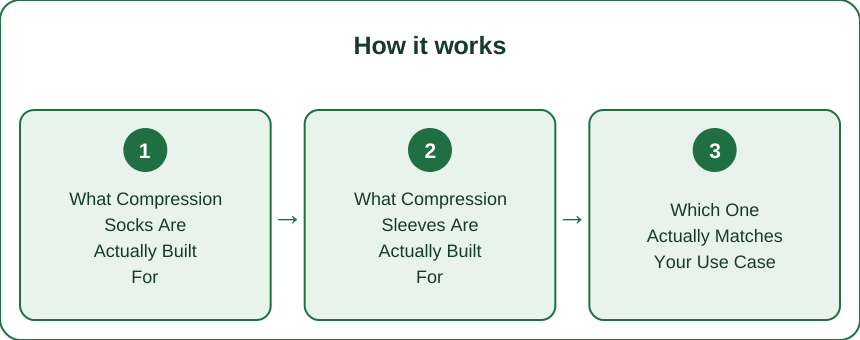
What Compression Socks Are Actually Built For
Compression socks cover the entire foot and lower leg, providing graduated compression that’s tightest at the ankle and gradually looser moving up the calf. This full coverage makes them particularly effective for circulation support — reducing swelling, supporting venous return, and easing leg fatigue during long periods of standing, sitting (like travel), or all-day wear.
Because they cover the foot too, they also function as a regular sock replacement, which matters for people wearing them through a full workday rather than just during exercise.
What Compression Sleeves Are Actually Built For
Compression sleeves cover only the calf, leaving the foot completely open. This design is preferred by many runners and athletes specifically because it allows any shoe or sock combination underneath, avoids added bulk inside running shoes, and improves breathability during high-intensity activity where foot overheating is more of a concern than lower-leg circulation.
Sleeves are generally easier to put on and remove quickly, which matters for athletes who want compression specifically during a workout but not necessarily all day.
Which One Actually Matches Your Use Case
Travel or long flights: compression socks — full foot-to-calf coverage supports circulation through hours of sitting.
All-day standing jobs (nursing, retail, teaching): compression socks — the extended wear and foot coverage matter more here than breathability.
Running or high-intensity workouts: compression sleeves — breathability and shoe compatibility usually outweigh the marginal circulation difference during shorter activity windows.
Recovery after a hard workout: either works, though socks offer slightly more complete lower-leg coverage if swelling extends to the foot and ankle.
What Nobody Tells You About Compression Levels
Both socks and sleeves are typically sold in different compression strength levels, measured in mmHg (millimeters of mercury) — mild (8-15 mmHg), moderate (15-20 mmHg), and firm (20-30 mmHg) are the most common consumer ranges. Many people buy based on sock-vs-sleeve style alone and never check the compression level, which actually matters more for the specific benefit (circulation vs. muscle support) than the style choice does.
Moderate (15-20 mmHg) is a reasonable general-purpose starting point for most healthy adults; firm compression is often better used under medical guidance, particularly for circulation conditions.
FAQ: Compression Socks vs Sleeves Questions, Answered
Do compression sleeves provide the same circulation benefit as socks?
Partially — sleeves support calf circulation but don’t cover the foot and ankle, so for full lower-leg circulation support (like on a long flight), socks provide more complete coverage.
Can I wear compression socks or sleeves all day, every day?
Moderate compression (15-20 mmHg) is generally safe for extended daily wear for most healthy adults, but check with a doctor first if you have any circulation conditions or diabetes.
Which is better for post-workout recovery, socks or sleeves?
Both are used for recovery, but if swelling or fatigue extends into the foot and ankle, socks offer more complete coverage; if it’s isolated to the calf muscle, a sleeve is sufficient and often more comfortable to sleep in.
TL;DR:
- Compression socks cover the full foot and calf — best for circulation, travel, and all-day standing
- Compression sleeves cover only the calf — best for running and workouts needing breathability and shoe compatibility
- Match the choice to your use case, not just personal preference between the two styles
- Check compression level (mmHg), not just sock-vs-sleeve style — it matters more for the actual benefit
Picking based on what you’re actually doing (travel vs. training) matters more than which style looks more familiar at the store.
See It in Motion
Seen here: High Waist Bootcut Yoga Pants with Side Pockets — shop it on bubblelime.com
Keep Reading
This article is for general informational and styling purposes only. Fit, sizing, and product availability may vary.