Compression Marks, Itching, and What Those Indentations Actually Mean
Quick Answer: Faint pink lines at seams and elastic edges that fade within 15 to 30 minutes are normal - that is surface pressure, not a problem. What is not normal: deep indentations that persist beyond an hour, numbness or tingling, colour changes in the foot, marks that pit when you press them, or any line that appears where there is no seam. Itching after removal is usually reactive hyperaemia - blood rushing back into skin that was compressed - and it settles quickly; itching during wear points to fabric, detergent, or moisture. The most common underlying fault is a garment that is too tight at one point rather than graduated along its length, which is a sizing or design problem, not something to push through.
Everyone has a version of this and almost nobody knows which lines to ignore.

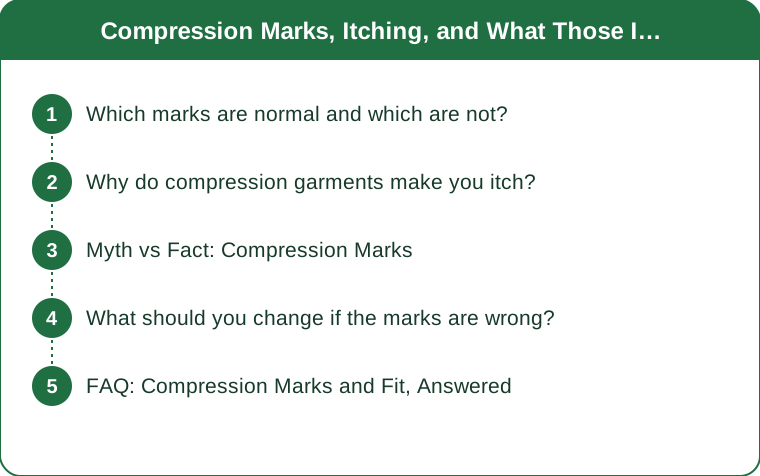
Which marks are normal and which are not?
Sort by depth and by how long they last, not by how alarming they look in the moment.
Normal - no action needed:
- Faint pink or red lines along seams, waistbands, and cuff edges, fading within 15 to 30 minutes. This is capillary compression and refill, exactly what happens after sitting on a textured chair.
- A visible waistband line after a long session, especially if you have been seated or bent at the waist.
- Warmth and pinkness of the whole limb immediately after removal, settling within minutes.
- Mild transient itching in the first few minutes after taking them off.
Worth changing something:
- Deep indentations that persist more than an hour. The garment is exerting more localised pressure than the tissue can tolerate.
- Marks that appear in the same place every time and get progressively deeper over weeks.
- A tight ring at the top of the calf or thigh with looser fabric above and below - the sign of a garment that has rolled, or a band sitting where the limb is widest.
- Itching during wear, which is a fabric, detergent, or moisture issue rather than a pressure one.
Stop wearing and seek advice for:
- Numbness, pins and needles, or burning in the limb, particularly on the outer thigh or the top of the foot.
- Toes or fingers going white, blue, or unusually cold during wear.
- Swelling that pits - press a thumb into the skin for a few seconds and if a dent remains, that is pitting oedema and it needs assessment rather than a different legging.
- Marks accompanied by pain, one-sided swelling, or calf tenderness, which needs prompt medical attention.
The single most useful test: does it fade within 30 minutes and does the limb feel entirely normal? Two yeses means it is a mark, not a message.
Why do compression garments make you itch?
There are three quite different causes and they are distinguishable by timing.
Itching immediately after removal: reactive hyperaemia. When pressure is released, blood flows rapidly back into the compressed area. Nerve endings register that surge, and the sensation is a prickling itch. It is harmless, lasts a few minutes, and is more pronounced the longer and tighter the garment was. Rubbing makes it worse; moving the limb gently and letting it settle works better.
Itching during wear: usually not the compression. The likely candidates, roughly in order:
- Trapped moisture. Sweat held against skin under an occlusive fabric softens the skin barrier and irritates it. This is the most common cause by a wide margin and it is worse in humid weather.
- Detergent residue. Compression fabrics are dense and hold detergent and softener. Fabric softener is a specific problem - it coats fibres, reduces wicking, and is a common irritant. Most compression care instructions say not to use it.
- Friction. Repeated rubbing at a seam or where the garment moves against skin.
- Contact allergy, which is genuinely uncommon but real - elastane itself rarely, dyes and finishing chemicals more often. It typically produces a rash matching the garment’s contact area rather than diffuse itching.
Itching in the days after: dry skin. Repeated wear plus washing plus hot showers strips the skin barrier, and dry skin itches. This is under-recognised in people who train daily.
What to do about each:
- Change out of damp compression within about 20 minutes of finishing.
- Wash without softener, rinse thoroughly, and consider an extra rinse cycle.
- Moisturise the legs on days you wear compression, after showering, on slightly damp skin.
- If a rash appears that matches the garment outline, stop wearing it and see a professional - contact dermatitis will not resolve while exposure continues.

Myth vs Fact: Compression Marks
Myth: Deep marks mean the compression is working properly. Fact: Effective compression is graduated and distributed, not concentrated. Deep localised marks mean pressure is concentrating at one point, which is the opposite of what a well-fitting garment does. The best-fitting compression often leaves the least dramatic marks.
Myth: If it hurts, it is doing something. Fact: Medical-grade compression is prescribed at specific pressures and is not supposed to hurt. Pain, numbness, and colour change are signals to stop, not signals of efficacy.
Myth: A tighter size gives you more benefit. Fact: Sizing down produces uneven pressure, rolling, and a band effect at the top, which can impede rather than assist return flow. Correct sizing is the entire mechanism in graduated garments, which is why medical compression is fitted by measurement rather than by dress size.
Myth: The itch means you are allergic. Fact: The great majority of post-removal itching is reactive hyperaemia, which is a circulatory response and not an allergy. True contact allergy produces a rash in the shape of the contact area and persists, rather than fading in minutes.
Myth: Marks fade with time as you get used to them. Fact: Skin does not adapt to excessive localised pressure. If a mark is deepening over weeks rather than staying constant, the garment is likely losing its even stretch and concentrating force at the remaining tight points - a sign it has aged out.
What should you change if the marks are wrong?
Work through it in this order, because the first two solve most cases.
1. Check the size against measurements, not against your usual size. Compression sizing is based on limb circumference, and manufacturers publish charts for ankle, calf, and thigh. Dress size is a poor proxy. If your calf measurement puts you in one size and your waist in another, this is the fundamental problem and no wearing technique will fix it.
2. Check whether the garment is rolling. A rolled waistband or a rolled cuff creates a narrow band of very high pressure at exactly the place you least want it. Rolling usually means the garment is too small, has lost recovery, or is being worn too high.
3. Check the age. Compression fabric loses elastic recovery over time. A garment that has lost recovery does not fail evenly - it stays tight where the fabric is densest and goes slack elsewhere, which is precisely how you get a deep line in one spot. Typical useful life for regularly used compression is measured in months of frequent wear, not years.
4. Check how you put them on. Bunching, yanking, and folding the top over all create pressure points. Gather the fabric to the foot, work it up in stages, and smooth as you go - never fold the waistband down.
5. Check the wash routine. Hot water, tumble drying, and fabric softener all degrade elastane. Cold wash, no softener, air dry.
6. Consider whether you need this garment at all. Compression has reasonable evidence for reducing perceived soreness, for symptom relief in venous conditions, and for travel-related swelling. Its evidence for improving performance is much weaker. If a garment is causing problems and its purpose is vague, the simplest fix is not wearing it.
When to see a professional rather than adjusting kit: swelling in one leg, calf pain or tenderness, skin colour changes, any pitting oedema, numbness that persists after removal, or if you have been advised to use medical compression and are unsure about fit. Sizing for therapeutic compression should be done by measurement, ideally by someone trained to do it.
This is general information, not medical advice. One-sided leg swelling with pain or warmth needs urgent assessment.
FAQ: Compression Marks and Fit, Answered
How long should marks take to fade?
Fifteen to thirty minutes for normal surface marks. Anything still visible after an hour suggests too much localised pressure.
Is it bad to sleep in compression?
Unless it has been recommended for a specific condition, it is generally unnecessary and increases the total hours of pressure without an obvious benefit. Garments designed for daytime activity are not designed for eight hours of stillness.
Why do I get marks behind my knee specifically?
The back of the knee is a crease point where fabric bunches when you bend, and it has thinner skin and superficial vessels. Some marking there is normal; deep marking suggests the garment is too long, too short, or bunching, and a different length often solves it.
Can compression cause varicose veins?
No - correctly fitted graduated compression is used to manage venous symptoms, not cause them. Poorly fitted garments that create a tight band at the thigh are a different matter and are worth avoiding.
Should I wear compression if my legs itch during exercise?
Exercise-related itching is common and often relates to increased blood flow in the skin rather than the garment. If it happens with and without compression, the garment is probably not the cause. If it happens only with, look at moisture and detergent first.
TL;DR:
- Faint marks that fade in 15 to 30 minutes are normal. Deep indentations lasting over an hour, or marks getting worse over weeks, are not.
- Stop and seek advice for numbness, colour changes in the foot, pitting swelling, or one-sided calf pain.
- Itching right after removal is reactive hyperaemia and harmless. Itching during wear is usually moisture, detergent, or friction.
- Deep marks mean concentrated pressure, not effective compression. Well-fitted graduated garments mark least.
- Size by limb circumference, not dress size, skip the fabric softener, and replace garments that have lost recovery - they fail unevenly.
If a line has faded before you have finished getting dressed, ignore it. If it is still there while you eat dinner, change the garment.
See It in Motion
Seen here: Super High Waist Embossed Yoga Leggings with Inner Pocket — shop it on bubblelime.com
Keep Reading
This article is for general informational and styling purposes only. Fit, sizing, and product availability may vary.