When Compression Gear Actually Helps (And When It's Just Placebo)
Quick Answer: Compression gear has reasonably solid evidence for reducing perceived muscle soreness and swelling (especially for travel and standing jobs), but weaker evidence for direct performance enhancement during exercise — knowing which claim applies to which use case prevents overpaying for the wrong benefit.
Compression wear marketing implies it does everything — boosts performance, speeds recovery, prevents injury. The actual evidence is more specific, and more useful once you know where it actually applies.

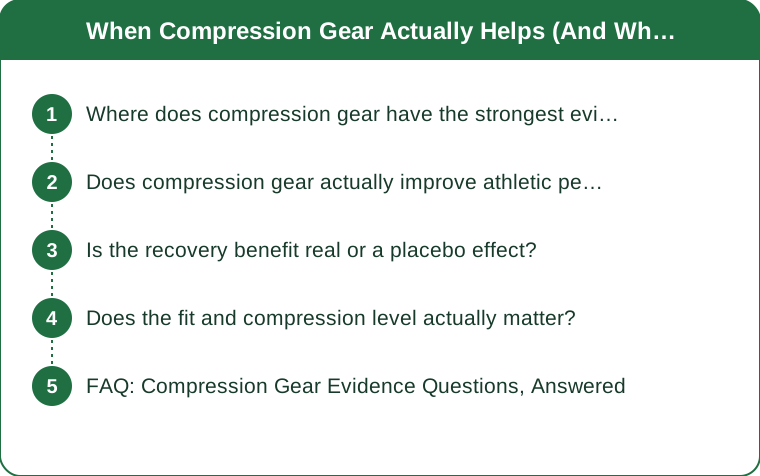
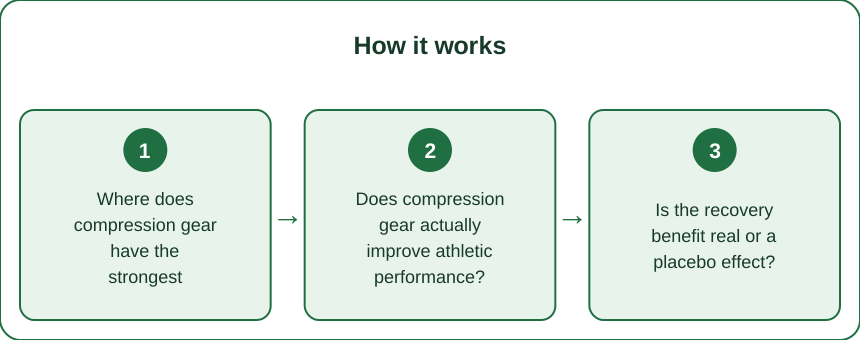
Where does compression gear have the strongest evidence?
Reducing perceived muscle soreness after exercise and managing swelling during long periods of sitting or standing (flights, standing jobs, pregnancy-related swelling) are the two areas with the most consistent supporting evidence. Graduated compression specifically — tighter at the extremity, looser moving up the limb — supports venous blood return, which is the mechanism behind both of these benefits.
Does compression gear actually improve athletic performance?
Evidence here is weaker and more mixed — some studies show small improvements in specific metrics, others show no meaningful difference, and the effect size when present is generally modest rather than dramatic. If performance enhancement is the primary reason for buying compression gear, expectations should be calibrated accordingly.

Is the recovery benefit real or a placebo effect?
Likely a mix of both, and that’s not necessarily a knock against it — perceived soreness reduction, even partially driven by placebo, still translates to a real subjective experience of feeling more recovered, which can support consistency in training. The swelling-reduction mechanism, by contrast, has more direct physiological support beyond placebo.
Does the fit and compression level actually matter?
Yes, significantly — compression that’s too loose provides minimal graduated pressure and functions more like regular tight clothing, while genuinely graduated, properly fitted compression is what the supporting research is actually based on. A poorly fitted “compression” garment may not be delivering the mechanism the evidence describes at all.
FAQ: Compression Gear Evidence Questions, Answered
Should I wear compression gear during exercise or just after?
Evidence for post-exercise recovery use is generally stronger than for during-exercise performance use, though both are commonly practiced and neither carries meaningful downside for most healthy adults.
Is more compression always better?
No — too-tight compression can restrict circulation counterproductively; graduated compression designed for the intended use (recovery, travel, medical) at an appropriate pressure level is more effective than simply maximizing tightness.
Do compression socks actually help on long flights?
This is one of the better-supported uses — graduated compression socks are commonly recommended for reducing swelling and discomfort on flights over about 4 hours.
TL;DR:
- Strongest evidence: reduced perceived soreness, swelling management (travel, standing jobs)
- Weaker evidence: direct athletic performance enhancement
- Some recovery benefit likely involves placebo, but that doesn’t make it useless
- Fit and actual graduated compression level matter — loose “compression” gear may not work as studied
This is general information, not medical advice — compression for medical conditions (like clots or lymphedema) should be guided by a doctor.
See It in Motion
Seen here: Super High Waist Embossed Yoga Leggings with Inner Pocket — shop it on bubblelime.com
Keep Reading
This article is for general informational and styling purposes only. Fit, sizing, and product availability may vary.