Compression Gear Myths vs. Facts: What the Research Actually Supports
Quick Answer: Compression gear has reasonably solid evidence for reducing perceived muscle soreness and improving subjective recovery feel, moderate evidence for reducing swelling during long periods of standing or travel, but weak or mixed evidence for actual injury prevention or meaningful performance enhancement during exercise itself.
Compression gear marketing often blends these categories together, but the research support varies significantly depending on which specific benefit is being claimed.
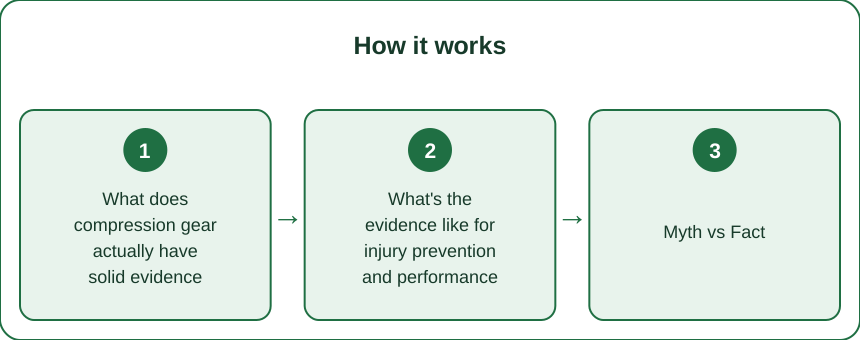
What does compression gear actually have solid evidence supporting?
Reduced perceived muscle soreness after exercise and improved subjective recovery feeling are among the better-supported benefits, with multiple studies showing measurable reduction in delayed-onset muscle soreness (DOMS) when compression garments are worn post-exercise.
Reduced swelling during prolonged standing, sitting, or travel is also reasonably well-supported, which is why compression socks are commonly recommended for long flights specifically.
What’s the evidence like for injury prevention and performance enhancement claims?
Injury prevention claims are notably weaker in the research — while compression may provide some proprioceptive (joint position awareness) benefit, evidence that it meaningfully prevents injuries like sprains or strains is limited and mixed across studies.
Performance enhancement during exercise itself (faster times, more power) also shows weak or inconsistent evidence — most performance-related benefit, where it exists, appears more in recovery after exercise than during the activity itself.
Myth vs Fact: Compression Gear Claims
Myth: Compression gear significantly reduces injury risk during exercise. Fact: Evidence for injury prevention specifically is weak and inconsistent; the stronger evidence is for recovery-related outcomes.
Myth: Wearing compression gear during a workout improves performance. Fact: Evidence for in-activity performance enhancement is mixed at best; post-exercise recovery benefit is better supported.
Myth: More compression (tighter garments) always means better results. Fact: Graduated compression at moderate, medically-informed pressure levels shows better results than simply maximizing tightness, which can restrict circulation if too extreme.
Does the level of compression (mmHg rating) actually matter for these benefits?
Yes — most positive research findings are based on graduated compression garments within a specific moderate pressure range (commonly 15-20 mmHg for general use), not simply the tightest garment available.
Overtightened, non-graduated compression can actually restrict circulation counterproductively rather than support it, meaning ‘tighter is better’ isn’t supported by the same research showing benefit from properly graduated compression.
FAQ: Compression Gear Questions, Answered
Is it worth wearing compression gear during sleep for recovery?
Evidence for overnight compression benefit is more limited than for waking-hours use; most positive research focuses on daytime post-exercise or travel use.
Do compression socks actually help with swelling on long flights?
Yes, this is one of the better-supported use cases, with reasonably solid evidence for reducing leg swelling during prolonged sitting or travel.
Should compression gear replace other recovery methods like stretching or hydration?
No — compression gear is best considered a supplementary recovery tool, not a replacement for foundational recovery practices like hydration, sleep, and stretching.
TL;DR:
- Compression gear has solid evidence for reducing perceived soreness and swelling from prolonged standing/travel
- Injury prevention and in-activity performance claims have weak, inconsistent evidence
- Moderate graduated compression (15-20 mmHg) outperforms simply maximizing tightness
- Compression gear works best as a supplement to, not replacement for, other recovery practices
The marketing bundles every benefit together, but the research is more selective about what compression actually reliably does. This is general information, not medical advice.
See It in Motion
Seen here: Super High Waist Embossed Yoga Leggings with Inner Pocket — shop it on bubblelime.com
Keep Reading
This article is for general informational and styling purposes only. Fit, sizing, and product availability may vary.