Compression Boots vs Compression Socks: Which One Actually Speeds Up Recovery?
Quick Answer: Compression socks provide continuous, mild pressure suited to all-day wear (travel, standing jobs), while pneumatic compression boots use active, pulsing pressure for a short session and are better suited to post-workout recovery — they’re solving different problems, not competing versions of the same product.
One costs about $20 and slides on like a regular sock. The other costs several hundred dollars and looks like something from a hospital recovery room. Here’s what the price and design difference is actually buying you, and whether it’s worth it for your specific situation.

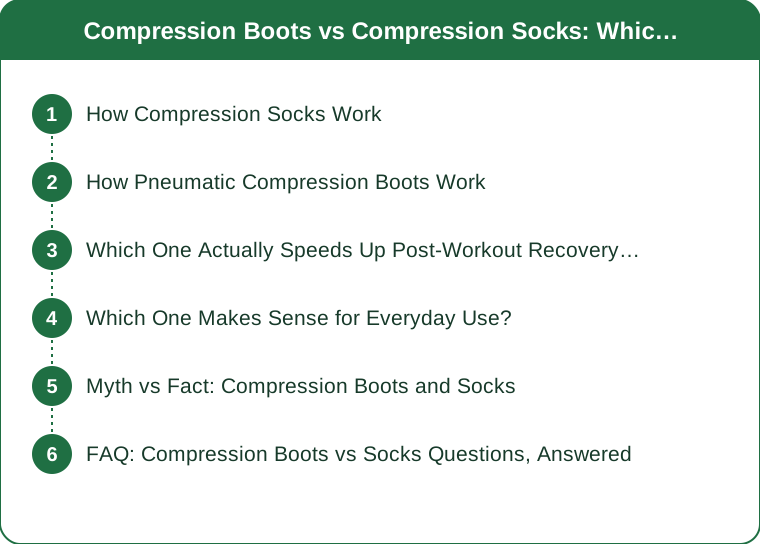
How Compression Socks Work
Compression socks apply continuous, graduated pressure — tightest at the ankle, gradually looser moving up the leg — using elastic fabric woven specifically to deliver that pressure gradient consistently. This constant, passive pressure helps push blood back up toward the heart against gravity, which is why they’re widely used for long flights, standing jobs, and everyday circulation support, and why they’re recommended by doctors for conditions involving venous insufficiency.
How Pneumatic Compression Boots Work
Compression boots use an air pump to inflate and deflate segmented chambers in sequence, creating an active pulsing or ‘milking’ pressure pattern that moves up the leg in waves rather than staying constant. This active pumping action is designed specifically to accelerate lymphatic drainage and blood flow after intense exercise, over a focused 15-30 minute session rather than all-day wear, mimicking in a mechanized way what a professional sports massage aims to achieve manually.
Which One Actually Speeds Up Post-Workout Recovery More?
For post-exercise recovery specifically, pneumatic boots have more research support for reducing perceived muscle soreness and speeding recovery between hard training sessions, because the active pumping motion more closely mimics the effect of a massage than static compression does. Compression socks can still help with general swelling and discomfort but aren’t primarily designed for this active-recovery use case, and studies comparing the two for athletic recovery specifically tend to favor the active pumping mechanism for perceived soreness reduction.

Which One Makes Sense for Everyday Use?
Compression socks are the clear pick for all-day situations — travel, retail or nursing shifts, pregnancy-related swelling — because they’re designed for continuous wear under normal clothes and shoes without drawing attention or requiring you to sit still. Pneumatic boots are a dedicated recovery session tool, not something worn throughout the day, and the equipment size and the connected air pump make that impractical anyway — nobody is wearing compression boots to work under their pants.
Myth vs Fact: Compression Boots and Socks
Myth: more expensive automatically means more effective for any given use case. Fact: for all-day circulation support specifically, a well-fitted pair of compression socks does the job a set of boots isn’t even designed for — spending more on boots for a use case socks already solve is money spent on the wrong tool.
Myth: you need medical-grade compression socks for any benefit at all. Fact: mild, over-the-counter compression (typically 15-20 mmHg) delivers meaningful comfort and circulation benefit for general travel and standing-job use; true medical-grade compression (20-30 mmHg and above) is generally reserved for specific diagnosed conditions under a doctor’s guidance.
FAQ: Compression Boots vs Socks Questions, Answered
Do I need both, or is one enough?
Most people don’t need both — pick based on your primary use case: socks for daily wear and circulation support, boots specifically if you’re training hard enough that recovery time between sessions is a real bottleneck in your performance.
Are compression boots worth the cost for a casual exerciser?
Probably not — the clearest benefit shows up for athletes training multiple times a week at high intensity; a casual exerciser is unlikely to notice enough difference to justify the cost over a good stretching and sleep routine, which delivers much of the same recovery benefit for free.
Can compression socks be worn during a workout, not just after?
Yes, and some runners do wear them during exercise for perceived support, though the stronger evidence for compression socks specifically points to recovery and all-day wear benefits rather than in-workout performance gains.
How do I know what compression level (mmHg) is right for me?
For general travel or standing-job comfort, 15-20 mmHg is the standard starting point most people reach for; anything stronger is worth discussing with a doctor first, especially if you have any circulation condition, since higher compression isn’t automatically better and can be uncomfortable or even inappropriate without a specific medical reason.
How long do compression boots typically last with regular use?
A quality pair used a few times a week generally holds up for a few years before the internal air bladders or pump start showing wear, making the upfront cost worth amortizing over that lifespan when deciding if the investment makes sense for your training frequency.
Is there a risk of using either one too often or too aggressively?
Overcompression from an ill-fitting sock or too-high boot pressure setting can restrict circulation rather than support it, so proper fit and starting at a moderate pressure setting matter more than assuming stronger is always better for either product.
TL;DR:
- Compression socks: continuous mild pressure, built for all-day wear (travel, standing jobs)
- Compression boots: active pulsing pressure, built for a focused 15-30 minute post-workout recovery session
- Boots have stronger evidence for speeding recovery between intense training sessions specifically
- Most casual exercisers get more everyday value from socks than from investing in boots
- 15-20 mmHg is the standard starting compression level for general use; go stronger only with medical guidance
See It in Motion
Seen here: High Waist Yoga Leggings with Side Pockets — shop it on bubblelime.com
Keep Reading
This article is for general informational and styling purposes only. Fit, sizing, and product availability may vary.